 Wildlife Removal Kansas City
 Raccoon Removal in Kansas City
Last updated: September 2026
Price ranges are compiled from national cost data + published local pricing, September 2026 — see the cost page for the full breakdown.
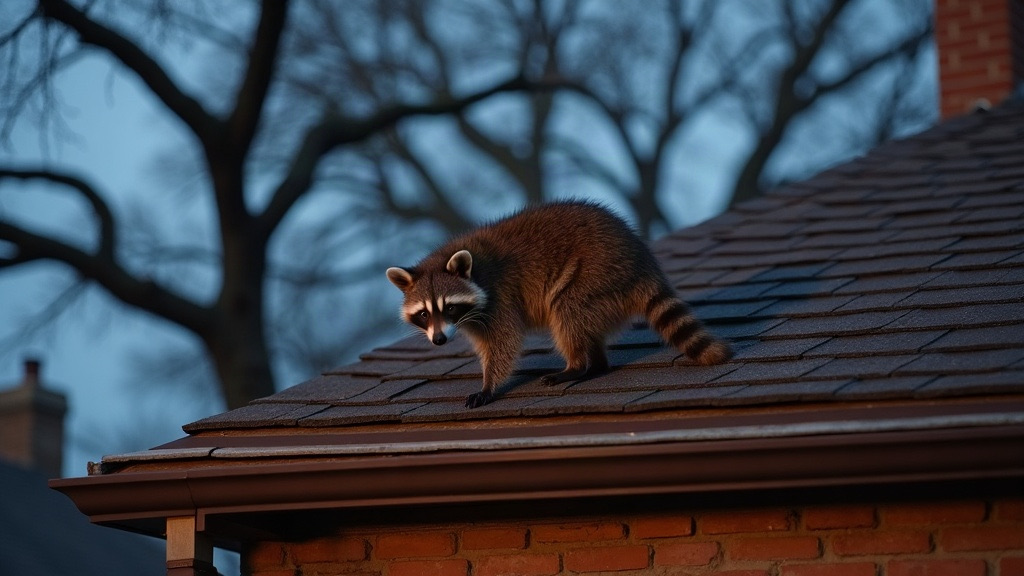
Kansas City Raccoon Removal Prices
Raccoon pricing scales with litters, access and contamination more than with the trapping itself.
| Job scope | Typical price range | Notes |
|---|---|---|
| Inspection | Free – $150 | Roofline plus attic; written entry-point findings are what honest quotes are built on |
| Trapping & removal (single raccoon) | $250 – $600 | Cage traps at the entry or on the roof, daily checks, removal |
| Mother with litter in the attic | $400 – $800 | Kits located and hand-removed for reunion — never sealed in or left behind |
| Exclusion / seal-up | $300 – $2,500+ | Heavy steel mesh, flashing, vent covers and chimney caps on every entry point |
| Latrine cleanup & insulation | $500 – $3,000+ | Raccoon feces can carry Baylisascaris roundworm — a contained cleanup, not a shop-vac job |
Signs You Have Raccoons (Not Squirrels or Bats)
Raccoons are the loudest tenants in Kansas City attics. The giveaway is heavy thumping and slow movement at night — raccoons are nocturnal and weigh 10–20+ pounds, so they sound like a small person overhead, not a mouse. Vocalizations — chittering, growling, and the crying of kits — confirm it. Squirrels, by contrast, are fast scamperers at dawn and dusk; bats chirp and flutter.
Physical evidence: a torn-open soffit, popped roof vent or peeled-back shingle (raccoons have the strength and hands to make their own hole); tracks like tiny handprints in mud or snow; tipped trash cans; and latrines — concentrated droppings on the roof, deck or in the attic. Raccoon feces can carry Baylisascaris roundworm, so cleanup is a gloved, masked job at minimum — this is one infestation where the contamination risk is as real as the structural damage.
Why Kansas City Has So Many Raccoons
KC is a raccoon city by design: the metro's mature tree canopy gives them aerial highways, its creeks and the Missouri and Kansas river corridors feed them, and its older neighborhoods give them dens. In Waldo, Brookside, Prairie Village and the pre-war districts on both sides of the state line, uncapped chimneys, aging soffits and gap-prone roof returns are everywhere — a raccoon needs only a four-to-five-inch gap, or the strength to make one.
The calendar matters too. Raccoons den hardest in two windows: spring (March–May), when mothers need a nursery for kits, and October–November, when the first hard cold sends them looking for heated shelter. Kansas City's cold winters are why attic raccoon calls spike every fall — and why a raccoon that moves in during November is usually there until spring unless removed.
How Professional Raccoon Removal Works
A legitimate job runs in sequence. Inspection: the technician walks the roofline and attic, confirms raccoons (not opossums or squirrels), finds every entry point, and checks for kits. Removal: cage traps at the entry point or on the roof, checked daily — and if it's a mother with a litter, the young are located and hand-removed so the family can be reunited, not sealed apart. Exclusion: once the raccoons are out, every gap gets sealed with heavy steel mesh, flashing and vent covers — foam and light screen don't survive a motivated raccoon. Cleanup: latrine removal and disinfection, with insulation replacement quoted separately if contamination is heavy.
The step that separates professionals from trappers-for-hire is exclusion. In KC's older housing stock, trapping a raccoon without sealing the roofline just vacates the unit for the next tenant — usually within weeks.
Missouri vs Kansas: The Rules on Your Side of the Line
Kansas City straddles two regulatory systems. On the Missouri side, raccoon work falls under the Missouri Department of Conservation's Wildlife Code: landowners have some latitude to address nuisance wildlife on their own property, but relocation of trapped wildlife is restricted, and commercial operators work within MDC rules. On the Kansas side, the Department of Wildlife & Parks (KDWP) requires commercial nuisance wildlife damage control operators to hold a permit — ask a Kansas-side company for theirs.
One practical rule applies on both sides: raccoons are a rabies-vector species, so relocation and handling are regulated everywhere. This is why DIY raccoon trapping that ends with "drive it to a park" is both illegal in most cases and epidemiologically unwise. The companies on our companies page work both sides of the line.
Who Removes Raccoons in Kansas City
Every company we list handles raccoons — it's the core call of the KC wildlife trade. Critter Control of Kansas City Metro runs dedicated lines on both the Kansas (913-912-8985) and Missouri (816-654-6922) sides; Catch-It Wildlife & Pest Control (Overland Park, since 1989) pairs removal with a biologist on staff; AAAC Wildlife Removal of Kansas City adds attic cleanup and insulation replacement; Frontier Trapper covers Johnson County with exclusion and insulation renewal; Cridder Ridder, All Seasons and Trutech round out the list. Profiles and published phone numbers are on our companies page, and the comparison table is on the home page.
Whoever you call, get the exclusion scope in writing before work starts — the written entry-point list is what makes raccoon quotes comparable. If cost is the open question, our cost guide has the honest ranges.
Frequently Asked Questions
How much does raccoon removal cost in Kansas City?
Typically $250–$600 for trapping and removal, including follow-up trap checks. A mother with a litter in the attic runs higher because the young must be located and hand-removed. Exclusion — sealing every entry point — is quoted separately at $300–$2,500 depending on the roofline.
Will raccoons leave my attic on their own?
Sometimes after the young are raised — but in Kansas City's cold winters they often stay for months, and a vacated den gets reoccupied. Raccoons also do steady damage while resident: torn ducts, compacted insulation and latrine contamination. Waiting is the expensive option.
Is it safe to trap a raccoon myself?
Raccoons are strong, bite when cornered, and are a rabies-vector species — and relocating trapped wildlife is restricted in both Missouri and Kansas. The bigger DIY failure is structural: without professional exclusion, the entry point stays open and the next raccoon arrives.
What if the raccoon is in my chimney?
A common KC scenario in spring — mother raccoons den in uncapped chimneys. Do not light a fire. Professionals trap at the chimney top and hand-remove kits; afterwards, a proper chimney cap is the permanent fix and part of any exclusion quote.
Talk to a Kansas City Wildlife Specialist Now
No forms and no waiting for a callback — one call connects you with a wildlife removal specialist serving the Kansas City metro, on both sides of the state line.
Call (235) 200-214624/7 — speak with a local specialist now