 Wildlife Removal Kansas City
 Skunk Removal in Kansas City
Last updated: September 2026
Price ranges are compiled from national cost data + published local pricing, September 2026 — see the cost page for methodology.
Kansas City Skunk Removal Prices
Location drives price: an open-yard capture is the cheap end, a den under a low deck with kits is the top end.
| Job scope | Typical price range | Notes |
|---|---|---|
| Inspection | Free – $150 | Confirms the den site and whether kits are present before any trap is set |
| Trapping & removal (deck, porch, shed) | $300 – $600 | Covered traps and calm handling — the no-spray protocol |
| Buried mesh barrier (exclusion) | $150 – $500 | L-shaped steel mesh a foot underground so the next skunk can't re-den |
| Odor treatment after a spray | $100 – $300 | For spray events on the structure itself; dog de-skunking is the home recipe in our FAQ |
The Kansas City Skunk Pattern: Under the Deck
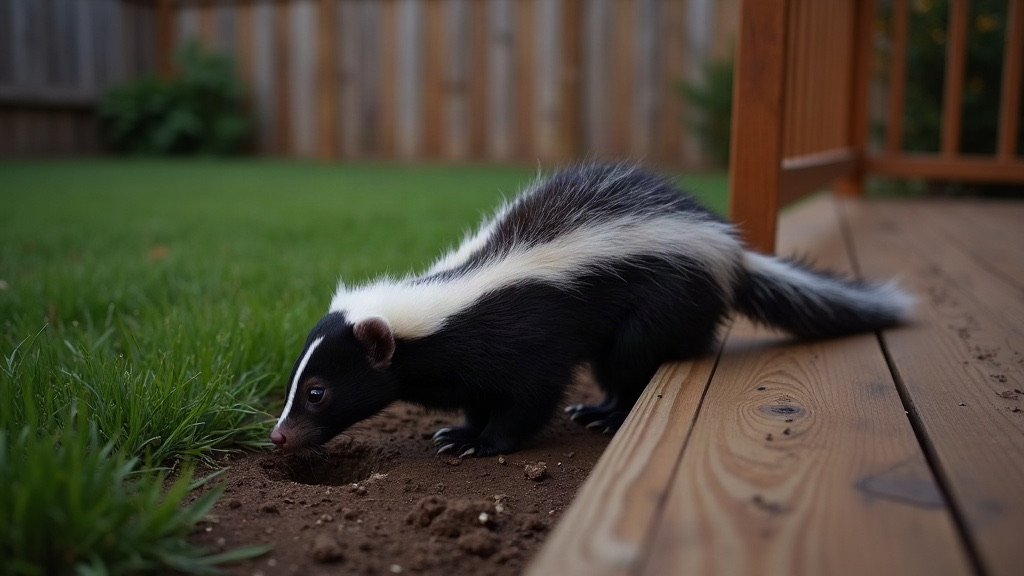
KC's skunk calls follow one dominant pattern: a skunk — usually a mother — denning under a deck, porch, shed or crawl-space opening. Decks are perfect skunk real estate: dry, dark, predator-proof, and heated by proximity to the house. The signs are a three-to-four-inch hole dug at the deck's edge, a faint persistent musk odor (not just after a spraying), nighttime waddling sightings, and in spring, the sight of kits trailing their mother across the yard at dusk.
Secondary signs around the yard: small cone-shaped diggings in the lawn where skunks grub for insects — the same behavior that draws them toward foundations and deck lines in the first place.
Why Skunk Removal Is a Specialist Job
Every animal removal has risks; skunk removal has an obvious one. A startled skunk sprays up to ten feet with accuracy, and a skunk in a trap is a startled skunk unless handled correctly. Professional practice: traps covered or wrapped so the animal stays calm, slow approach, and transfer without triggering the spray response. The companies that do this daily almost never get sprayed; homeowners improvising with a hardware-store trap almost always do.
The second risk is legal and medical: skunks are a rabies-vector species in Missouri and Kansas, so handling and relocation are regulated — KDWP-permitted operators on the Kansas side, MDC Wildlife Code on the Missouri side. A skunk active in daylight, staggering or unusually tame is a rabies suspect: keep pets and people away and call a professional the same day.
Removal Plus Exclusion: Keeping the Next Skunk Out
Removing the skunk solves this month's problem; the den site solves next month's. Once the animal is out, the standard fix is an L-shaped buried mesh barrier: heavy-gauge steel mesh attached to the deck or porch base and extending a foot underground outward, so digging animals hit mesh instead of soil. Sheds and crawl-space openings get the same treatment.
Timing matters in one window: late spring, when kits are old enough to follow their mother but not yet independent. Trapping a mother while kits are under the deck leaves you with dying, spraying kits in an inaccessible void — a legitimate company will verify whether young are present before setting a single trap.
When Skunks Den: The KC Calendar
Skunk pressure in Kansas City has its own rhythm. February–March is breeding season — the peak month for spray incidents, as males wander and dogs object. April–June is kit season: mothers den under decks and sheds, and this is the window when trapping without checking for young goes badly wrong. Late summer and fall, the year's kits disperse and look for their own den sites — that's when a fresh hole appears at a deck that never had one. Winter skunks in KC don't truly hibernate; they den up communally under structures and emerge on warm nights, which is why January spray smells still happen.
The homeowner's takeaway: the cheapest skunk job is the October exclusion check — walk the deck line and shed perimeter before denning season, and close gaps while nobody's living under them.
What You Can Do Before (and Instead of) Calling
For a skunk merely passing through — no den hole, just lawn diggings — the fixes are habitat-based: secure trash, bring pet food in at night, and reduce grubs if the digging is heavy. Mild harassment (light, noise, a radio under the deck for a few nights) sometimes convinces a newly arrived skunk to den elsewhere — worth trying in fall or winter, not when kits may be present.
Skip the folklore: mothballs under the deck are toxic to everything including your household, ammonia soaks are temporary, and ultrasonic devices have no credible evidence. If there's an established den hole, or any chance of young, call one of the companies on our companies page — the removal itself is usually the cheapest part of getting this wrong.
Frequently Asked Questions
How much does skunk removal cost in Kansas City?
Typically $300–$600 for trapping and removal from under a deck, porch or shed, including trap checks. Exclusion — a buried mesh barrier around the structure — adds $150–$500 and is what prevents re-denning.
How do professionals keep from getting sprayed?
Covered traps, slow movement and calm handling: a skunk that can't see the threat and isn't startled rarely sprays. Wrapped traps are standard practice at the KC companies we list — it's one of the clearest reasons this is not a DIY job.
Are skunks in Kansas City dangerous?
Beyond the spray, skunks are a rabies-vector species in both Missouri and Kansas. Any skunk active in daylight, disoriented or unusually approachable should be treated as a rabies suspect — keep distance and call a professional the same day.
How do I get skunk smell off my dog?
The effective home recipe: one quart of 3% hydrogen peroxide, a quarter cup of baking soda and a teaspoon of dish soap, worked in fresh and rinsed thoroughly (don't store the mixture). Tomato juice mostly masks the odor. Then find the den — a sprayed dog usually means an established one nearby.
Talk to a Kansas City Wildlife Specialist Now
No forms and no waiting for a callback — one call connects you with a wildlife removal specialist serving the Kansas City metro, on both sides of the state line.
Call (235) 200-214624/7 — speak with a local specialist now